Monday, February 14, 2011

Seventeenth Session - Part 1: Journey to the Undred-Undred Teef


What I Had Planned
So this was going to be the last session that we had before the holidays. I was really trying to make it a big one. As it turned out the group was about to embark on a tremendous endevour - a journey to the Undred-Undred Teef to rescue what they believed to be 10 missing vessels from their Dynasty's fleet. A successful rescue would mean that the Explorers would now actually have a fleet of ships, not just a single frigate.

The set pieces I had planned out were:

1) A fateful meeting with a lost vessel - one of the Holocene Dynasty's lost ships. And a chance to spotlight the Seneschal and Rogue Trader.

2) An interactive cutscene.

3) Big space battle where the PCs had to get their ship into position against a large number of ork vessels. It would feature ork ram ships which would be raiders who attempted to just ram the PCs ship over and over.

4) A vehicle battle where the PCs would deploy vehicles onto the hull of a giant space cruiser and fight across the hull to get to a particular point.

5) A boarding mission to get to a critical part of the ship.

As I type this up, I can see now that this was entirely too much to try to cram into one session. Well, live and learn.

The Tau and a Warning
As the Explorers set out for the Undred-Undred Teef, the passed by the Lucin's Breath system and there learned that the Tau were performing massive excavations of the planet that they had raided, evidently looking for something big and buried in the ground. It wasn't hard to make a connection to the hidden alien vault on Vedic.

The Rogue Trader himself spent his time while traveling to the Undred-Undred Teef aboard the allied vessels of the rag-tag fleet they had assembled. Basically consorting with the other captains, making preparations for the raid, coordinating plans, etc.

Then, deep into their journey, they suddenly ran into a strange vergence in the Warp. A massive, rapidly expanding bubble of psychic energy. Large as a supernova, and rolling across parsecs of space.

The crew's Astropath was skilled enough to basically function like a lightning rod and ground the psychic phenomenon - preventing the entire crew of the Ferral Wolf from going mad. However, as I told the players, the other vessels following them into the Undred-Undred Teef might not be so lucky. After a few rolls, I determined that they had lost some of their allied ships had been lost.

That's when the Seneschal's player said, "Wait. Which vessels were lost? Remember, the Rogue Trader was on one of them."

I let the players make a luck roll...and they blew it. Which meant that the Rogue Trader himself was on one of the vessels that had been lost. Not only that, he was on the Nihontu, a statted-out NPC vessel. Captained by Lady Kitsune. (Both the Nihontu and Lady Kitsune [appearing as Lady Sun Lee] appear in Lure of the Expanse.)

I inwardly winced. I liked that NPC and that ship. I had had plans for it. But, for me, part of the fun of roleplaying is dealing with the unexpected. Dealing with loss. Wrestling with stuff that throws your plans to hell.

Madness Aboard the Nihontu
What happened next was a desperate, off- the-cuff adventure. The Rogue Trader himself was aboard the bridge of the Nihontu when 50% of its crew suddenly went mad with the power of the psychic disturbance. The ship's Astropath was able to prevent the other 50% of the crew from succumbing to insanity, but that was sadly not enough.


As comrades and even family members turned on each other, Lady Kitsune made for way to the Navigator's chambers. I had the Rogue Trader basically make a Skill Challenge roll to see if they could fight their way there. (Basically, I had him make a series of tests, needing X number of degrees of success total.)

He failed, so I ruled that in the ensuing battles to get to their goal, he took some wounds. 3d10 worth. I rolled the dice and the wounds were enough to actually put him in critical wounds. He went unconscious. When he woke up, their was Lady Kitsune, barely alive but disemboweled. There was nothing to be done for her. For me, this stung again because she was a named NPC who I had some plans for. But, I thought to myself, if you're going to have a player roll and that player fails, there needs to be some tangible consequences.

To honor her, the Rogue Trader made his way to the room where the Nihontu's Warrant of Trade was kept, intending to give it back to her Dynasty. There, he meant the Nihontu's own Arch-Militant, deep in the throes of madness and singing to his own power sword.

Now, the Rogue Trader found himself with Critical Wounds facing down an unscratched arch-militant in power armor and wielding a power sword. Fortunately for him, the arch-militant was quite mad and not fighting his best (he neglected to parry or dodge), but all the same, a single hit from the power sword would easily have cleaved the Rogue Trader in two. The Rogue Trader did have an edge, however. The Luminous Reproach - an artifact weapon the crew had gained in a previous session.

Meanwhile, the rest of the Explorers made a mad dash to attempt a rescue of their captain. I had them make a Skill Challenge test and they passed it to find the Nihontu, and then I had the Arch-Militant of the Ferral Wolf make another one to see if he could get there in time. Patrick (the AM's player) blew his test out of the water, so I let him describe how the rescue attempt went.

He proceeded to describe his great, hulking character plowing through the walls of the Nihontu itself, shearing away bulkheads, and power-fisting through beams to save his lord and master. Upon their arrival, they came upon the Rogue Trader who had just put down the rival Arch-Militant with two solid strikes of the Luminous Approach. They took the Warrant of Trade from the Nihontu and left to return to the Ferral Wolf.

Thoughts on Using Skill Challenges
While Skill Challenges are not in the Rogue Trader rules specifically, they are hinted at in the form of Exploration Challenges in the game. They also appear somewhat in the form of Social Challenges from Into the Storm.

The whole Skill Challenge thing came about with 4th Edition D&D and has been quite controversial every since. There are some who praise it for allowing more free-form, free-flowing storytelling; but others decry it for being used to throw dice instead of roleplay. (Some cool comparison of 4e vs. Rogue Trader skill challenges here.)

Unfortunately, I have seen it used far more for the latter rather than the former. Stuck in a swap with your buddies? Skill challenge! Okay, you're out. Need to sneak out of a city? Skill challenge! You're out!

In my case, what I've tried to do is to use Skill Challenges to fulfill some of the core themes of Rogue Trader. This is one of the harder aspects of running a Rogue Trader game - capturing the spirit of the game itself. The game that is implied in-between the lines of text in the core rulebook. One of the ideas that I gleaned from the Rogue Trader Core Rulebook was the idea of "fast-fowarding to the good stuff".

The whole idea of an Endeavour (collapsing large, board actions into a simple card or list), really points to the idea of campaigns in which you can participate in world-shaking events such as conquering a planet, but each of these Herculean tasks is only supposed to take a portion of your campaign.

To that end, I've often used Skill Challenges - not to bypass the cool roleplaying in the game - but to essentially fast-forwards to the most exciting and climactic parts. For example, I could have rolled out the battlemaps and allowed the Rogue Trader to move his mini up the hallway, fighting as he went, and then the rest of the players could have watched him for over an hour. And then he could have sat idly by while the rest of the party marched down the miniatures map in an attempt to rescue him, all the while fighting crazed crew members. Such an encounter might actually have been very cool with the proper maps and figures. However, it would have also taken the entire session and most likely the next one as well.

Instead, I used the Skill Challenges to get to the good parts of the story so that all of the players could move on to get to what they were aiming for in the first place...the Undred-Undred Teef. In the end, it seemed to work out well for us. Everyone had a good time.

Thursday, February 10, 2011

Glorious Failure


Now, for most of this blog I've been crowing about my own successes here. And overall, the campaign has been a tremendous success. My players have said as much.

But it hasn't been all Hollywood Blockbusters and Oscar Awards all around. There have been a great deal of problems in the game. It's easy to celebrate your own successes on a public forum. It's sometimes a bit more difficult to talk about what you did wrong. Especially out in public.

But let's talk about that. My failures in this campaign. I was going to write a single post about the subject, but then I found myself writing pages of text. Clearly, this isn't going to be something I tackle with a single post. So, we'll probably see a series of these throughout the blog.

A Tough Game
The Rogue Trader campaign has easily been the hardest campaign I've run in recent memory. The only other game that gave me this much trouble dates back to '03-'04. Yeah. Seven to eight years ago. I still remember it vividly. And no, that was not any game that I played with the Minions of the Monster Master. With the Minions, we were fortunate enough to knock it out of the park almost every time. (Much love to the Minions, BTW, for mentioning one of our old, great campaigns. They even put up pics!)

But even though I remember the '03-'04 campaign being fraught with mistakes, misfires, and downright failures - I also remember having a really good time, and learning a lot from what went wrong. More than I learned from my more successful campaigns.

Outside Problems
One problem our campaign has faced (and we've been extremely lucky to weather this) is a changing player roster. We lost players. Gained players. Had players come and go. Thought we were going to lose players, but then didn't.

The game started out with the loss of Casey, one of our most energetic and enthusiastic players. Losing a good player is very difficult, especially if that player brings a lot of energy to the table. A player who is like a cheerleader for your campaign is, in my opinion, invaluable. Players like that get everyone excited about the game, and maintain its momentum.

Then, we had another player Nick, who had to leave the game for months at a time due to work. We had another player, Doug, who thought was going to have to leave. To fill his spot, we invited another player, Rob, into the game. And then, it turned out that Doug didn't have to leave.

All of this resulted in a game that eventually got too big. At the top, it had a total of seven players. In my opinion, that's too many for a game like Rogue Trader. Because of the way I'm running it (sort of like Birthright), each character has to command either a sizable group of people, or make key decisions about important parts of the ship. This means that often, the game will focus solely on one character. In a big group, it's very difficult to get that spotlight onto every single person. Also, a game of this kind is going to feature a lot of long periods of political discussion and interplay. In a big group, quieter players can lose out.

I don't know if I would call this a mistake per se, because it was no one's fault, but it was probably one of the biggest problems in our game.

Now, luckily, this continually changing roster of players did not kill our campaign, as it might have with many groups I've been in. I think we can credit that to the fact that our group as a standing, set-in-stone, gaming night. But making game night a regular thing, our campaigns don't tend to die off before the end. As a result, so far, we've completed three different campaigns in about six years. That means that we seen the beginning, middle, and end to three different campaigns.

How the Game is Supposed to be Run?
In my opinion, if you read the adventure in the back of the Rogue Trader core book, or read through Lure of the Expanse, the designers seem to want you to run the game like Star Trek. Even though you command 30,000 or even 100,000 people, you and the command crew are the only ones that really count. So, of course you deploy to the unexplored planet with your Navigator. Of course you enter the ruins with your lead Astropath. Can you run a Rogue Trader game like that successfully? Of course you can. And I think you can do it very well, because the game is designed to support that sort of play.

However, we had already run a game very much like this in our previous campaign in the Iron Kingdoms. I wanted something different. I wanted a game that felt like you were in charge of a dynasty, not just a ship. A game that would be like Battlestar Galactica, but where you don't play Starbuck or Apollo...you play Admiral friggin' Adama.

Now, a game like that can have it's problems. Like T-Bone of the Minions stated, you can end up with a game where all you do is manage people. As T-Bone manages people in his day job, he surely didn't want to do that on game night! So you have to be careful. Another problem that I ran into was that I've never run a game like that. Nor are games of that nature ubiquitous.

At that point, what I wished I had understood was that I was now taking the game in a direction far outside the confines of the rules and how the rules were even organized. Sure, there are things like the Endeavour System or Profit Factor which help create a sense of epic-ness, but there simply aren't (currently) solid rules on mass combat or mass ship combat. There is a small write-up on squad-based combat, but it's very short and unfortunately shallow.

What I wished I had done was....


What I Should Have Done
I should have done was understand the game a bit more before running it. And then implemented some solid, defined house rules. Things like house rules for mass combat. Mass ship combat. Things like that.

The reason I say that is that often I've had to do these things sort of on the fly. And while it has worked, the small sub-systems I've come up with have not been consistent. It sort of cheats the players, because they have a hard time knowing what to expect. We'll see how I do implementing these things from here on out.

Tuesday, February 8, 2011

The Orks is Comin'!


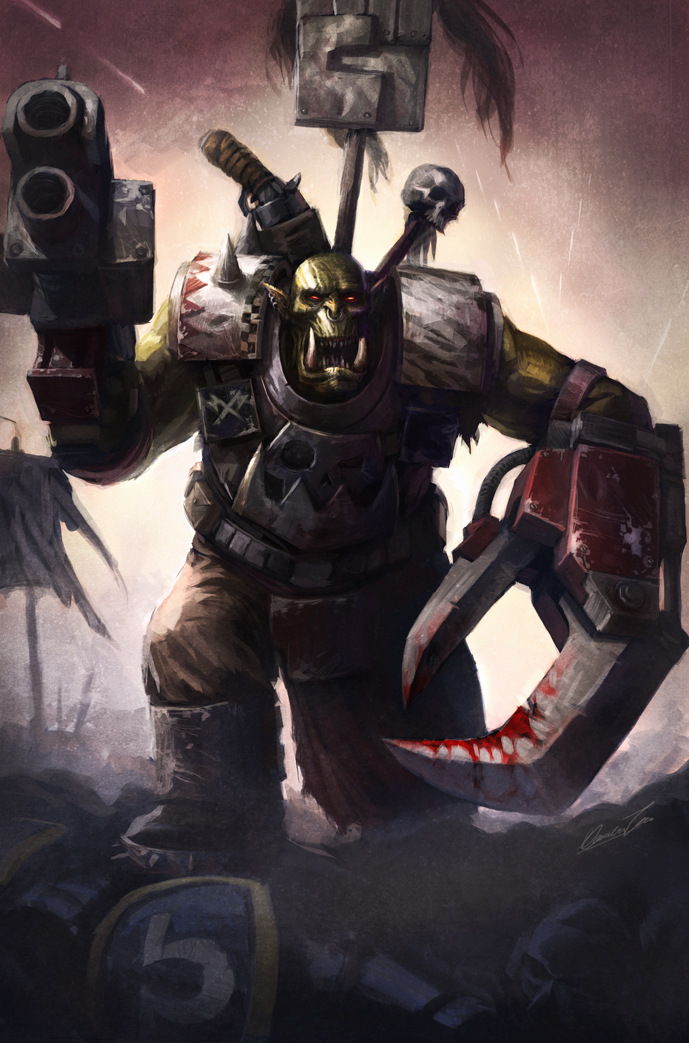
Well, for the big battle, I made up a bunch of stats for ork vehicles as well. I didn't use most of them, because...well, you'll see later...but I made them up anyway.

Not using stats that I make up is not bad by any means. There are always opportunities down the road for these things to show up.

One thing that I tried to do was to keep it close to the 40k stats as I possibly could. Simply because it was a design challenge and because the Warhammer 40,000 rules have fantastic flavor. And if I could capture some of that flavor in my own stats, it would have been a victory for me.

Ork Blasta Tank

Type: Ground Vehicle Tactical Speed: 10m
Cruising Speed: 50 kph Manuoeverability: -5
Structural Integrity: 25 Size: Enormous (+20 to hit -20 to conceal)
Armour: Front 40, Side 30, Rear 20 Special: Unreliable – 20 to repair
Crew: Driver, Gunner, Crew Chief

Weapons:
Position: Gunner
Great Big Shoota (Front); Range: 300 to 700 m (1d5+2 AUs), Heavy, RoF: S/-/-; Damage: see special; Clip: ?, Reload Full; Special: Random Fire – Roll 1d5 to determine what kind of shell is fired.
1) Boom Shell 3d10+20, Pen 20
2) Tank Hamma Shell 8d10, Pen 0
3) Burna Shell - vehicle catches fire, 1d10 to structural integrity until put out
4) Scrap Shell – 3d10, Pen 0, Vehicle takes a 1d5 crit hit
5) Dud

Ork Fighta Bomma

Type: Craft Tactical Speed: 20m / 22 AUs
Cruising Speed: 1,600 kph / 5 VU Manuoeverability: -5
Structural Integrity: 25 Size: Massive (+30 to hit -30 to conceal)
Armour: Front 25, Side 25, Rear 20
Crew: Pilot, Crew Chief/Bomma, Forward Gunner, Rear Gunner

Weapons:
Position: Forward Gunner
Twin-Linked Big Shoota x1 (Front); Range: 600m (6 AUs), Heavy; RoF: S/-/-, Damage: 5d10+10 I, Pen 10; Clip: -; Reload -; Special: Twin-linked (+20 to hit, 2 shots fired)

Position: Rear Gunner
Auto Cannons x2 (Sides); Range: 300m (3 AUs), Heavy; RoF: S/2/5, Damage: 4d10+5 I, Pen 4; Clip: 60, Reload 2 Full; Special: None

Position: Bomma
Big Boms: Range: 0; RoF: -; Damage: 3d10+20 X, Pen 20; Clip: -; Reload 2 Full; Special: Blast (10)

Ork Stompa


Type: Walker Tactical Speed: 5 m
Cruising Speed: 30 kph / 1 AU Manuoeverability: -20
Structural Integrity: 65 Size: Massive (+30 to hit -30 to conceal)
Armour: Front 35, Side 35, Rear 30
Crew: 2 Drivers

Weapons:
Position: ?
Twin-Linked Big Shoota x1 (Front); Range: 600m (6 AUs), Heavy; RoF: S/-/-, Damage: 5d10+10 I, Pen 10; Clip: -; Reload -; Special: Twin-linked (+20 to hit, 2 shots fired)

Position: ?
Deth Kannon x1 (Front, Sides); Range: 600 m (6 AUs), Heavy, RoF: S/-/-; Damage: 4d10+20 E, Pen 15; Clip: 250, Reload -; Special: Inaccurate (No bonus for aiming)

Supa Skorcha x1 (Front, Sides); Range: 30 m (0 AUs), Heavy, RoF: S/-/-; Damage: Special; Clip: -, Reload 2 Full; Special: catches enemy on fire, 1d10 to structural integrity until put out
>

Saturday, February 5, 2011

Making Up Stats for the Big Fight


So I knew that I wanted to stage a really epic and momentous battle in the Undred-Undred Teef. I So, as I did with the Battle at Footfall, I started sketching out set-pieces. One of the set-pieces I started arranging was a big vehicle battle.

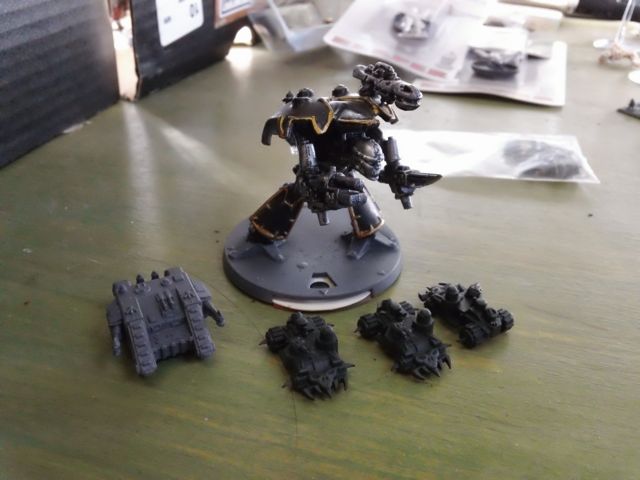
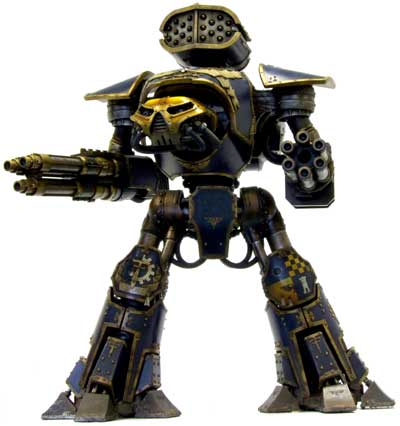
Some time ago, towards the beginning of the campaign, even, the Explorers had discovered a Reaver Titan and believe me, they never let me forget it. And on top of that, one of my players went out and bought a large quantity of epic scale miniatures. Including a titan mini! No, not that Titan mini. No one in my group has that kind of money lying around. In any case, such an opportunity cannot be missed.


Look at the cornucopia of minis Nick bought for the campaign! There are troops on bases, here, mostly. As well as some tanks (grey-colored on the right). The Reaver Titan is prominent, of course.

Here is a close-up of the Titan and some tanks. I painted the Titan.

I went about making up a large scale vehicle battle using the Into the Storm rules. The only problem was that there were only a few stats for vehicles in Into the Storm. I had to make a lot of them up. Luckily, there was still the Dark Heresy apocrypha, which contains stats for vehicles. But those stats were incomplete compared to the Into the Storm write ups.

So, I had to make a number of the vehicles up. Particularly the Reaver Titan, of course.

I thought I would share them here, and perhaps save some fellow GM the trouble of having to do it. No doubt people will see something wrong in these. No problem at all. It may at least give others a starting point.

As I were, I only needed to make up three stats for the good-guy team. The Leman Russ, the Reaver Titan, and some rules for their mysterious Scylla flyer. The team bought Calixis-pattern Fury Interceptors and the Into the Storm book already had rules for those.

Rogue Trader Vehicles

Leman Russ Tank


Type: Ground Vehicle Tactical Speed: 10m

Cruising Speed: 50 kph Manuoeverability: -5

Structural Integrity: 35 Size: Enormous (+20 to hit -20 to conceal)

Armour: Front 40, Side 30, Rear 20 Special:

Crew: Driver, Gunner, Crew Chief

Weapons:

Position: Gunner

Twin-Linked Autocannon x1 (Front); Range: 300 m, Heavy, RoF: S/4/10; Damage: 4d10+5, Pen 4; Clip: 40, Reload: 2 Full; Special: Twin-Linked (+20 to hit)

Turrent-Mounted Lascannon x1 (Front, Sides, Back); Range: 300 m, Heavy; RoF: S/-/-; Damage: 5d10+10, Pen 10; Clip: 10; Reload: 2 Full; Special: Twin-Linked (+20 to hit, Fires 2 shots)

Reaver Titan


Type: Walker Tactical Speed: 5 m

Cruising Speed: 45 kph / 1 AU Manuoeverability: -20

Structural Integrity: 65 Size: Massive (+30 to hit -30 to conceal)

Armour: Front 40, Side 45, Rear 40 Void Shields: 40%

Crew: 1 Drivers, 1 Tech Priest, 2 Servitors

Weapons:

Position: Tech-Priest

Carapace Mounted Rocket Launcher (Front/Left/Right); Range: 75km (750 AUs), Heavy; RoF: S/4/8, Damage: 3d10+20 X, Pen 15; Clip: 24; Reload -; Special: Burst and Auto Fire

Position: Pilot

Arm Mounted Turbo Laser Battery x2 (Front); Range: 700 m (7 AUs), Heavy, RoF: S/-/-; Damage: 8d10 E, Pen 10; Clip: 1, Reload 2 Full; Special: Blast (10)

I'll put the ork vehicles I made up in the next post.

Monday, January 31, 2011

Sixteenth Session - Preparing for the Grand Battle


Now that the battle at Wake had been resolved, our Explorers prepared themselves for their next great venture - entering the Undred-Undred Teef.

Somewhere around Session Twelve the characters had received the second half of the Witch of Footfall's prophecy, telling about the lost fleet of the Holocene Dynasty. Indeed, the Seneschal of the group received a vision about it.

Now, our PCs made their final preparations to enter the Undred-Undred Teef and perhaps reclaim some of the lost vessels - literally a treasure trove of possibilities. As they weighed their options, the crew first took stock of the situation.

First of all, they discussed the appearance of the Tau. Even though the Tau Empire was on the other side of the galaxy, they had appeared nearby. How? To their surprise, their resident Scylla on board provided the answer. The Scylla were part of the Tau Empire and, from time to time, loaned out their ability to fold space. This was a major revelation that had them talking for some time.

Also, the crew negotiated carefully with Jeremiah Blitz, which some people may recognize from the Lure of the Expanse. After finding one of his ships disabled out by the Lucin's Breath system, they negotiated its return in exchange for a trade agreement with Blitz himself. Finally, the crew had established a trade route to their colony on Vedic, which completed one of their long standing Endevours to establish a colony of their own.

The Explorator was able to get the schematics for some personal shields for the crew. However, to do so, he had to make a deal with the heretek pirate of the Red Glaive. It will be interesting to see how this develops.

Lastly, the Rogue Trader himself had long ago put out a call at Footfall for people to join the dynasty in a daring raid upon the Undred-Undred Teef. And in response, no less than twenty ships arrived, hoping to follow the Holocene Dynasty's lead into fortune and glory.

After this session of politics, trade, and discussion - we were ready for the crew's true moment of destiny.

Friday, January 28, 2011

The Problem with Knowledge Skills


One problem I’ve always encountered in roleplaying games is the “knowledge check” dilemma. At most tables I’ve played at, if a player has a knowledge skill, they activate it by rolling the skill. If they succeed, the GM tells them aloud what they know about a particular topic. Then, the player does one of two things. They either repeat the same thing that the GM just said…which now seems redundant. Or they simply turn to the rest of the group and say, “I share this with the party.”

Either way, this results in the spotlight being moved away from the character with knowledge skills. Furthermore, this makes knowledge-based characters extremely boring to play. If you’re a wise, knowledgeable character, your speciality is to have GM to tell you stuff while you passively listen.

In most of my games, I’ve tried to combat this with the sidebar. I pull the player aside, tell them what their character knows, then let them go back to the table and relate it to the group. This has worked brilliantly in the past. Often, when the player retells the information, they will put their own spin on it, making the information slightly colored or biased – which it should be. Also, it enhances roleplay, since the players can talk about the new information in character.

However, with a big group, this has proved detrimental. Constantly pulling players aside with a big group pauses the action, and with a group as large as ours, it often caused more distractions.

So, what to do? I ended up robbing an idea from myself.

Some History
Back in the day, I used to write a lot of adventures for the Living Death Campaign for the RPGA.

For those not familiar with living campaigns or organized play, the idea is that you make a character using a typical set of RPG rules and then are able to take that same character to different conventions around the country and advance them. Eventually, organized play evolved so that it incorporated home play as well. Now, you can take a character from your own "home game" and plug him/her into just about any convention with gaming in it around the country.

During those years, I noted that often certain skill checks would come up time after time. The Living Death Campaign was a horror game set in 1890's Gothic Earth, so there was always a lot of rolling "Forbidden Lore" or other types of investigative skills.

In the modules that I wrote, I started putting in bulleted lists of information, telling the result of different kinds of rolls that I knew were going to inevitably come up. For example, in a module, I would have a list of information that you might be able to get from a Forbidden Lore check. And this information was incremental, telling how much information would be released based on how high the skill check was.

Cards with Information
So, to avoid the incessant sidebars, I've started printing up pre-written blocks of information for different kinds of skill checks throughout the game. I try to make the cards look attractive and aesthetic. That way, the players know they are getting something special. And they are easy to hold onto for players who like to do that sort of thing.


For really big, earth-shattering revelations, I can even dress up the information cards with a picture or something like that. This really calls attention to the information and gives the player something visual to latch onto.

The best part? It doesn't slow down the game at all. I just pass it to the player and the game rolls on without pause. This doesn't mean that I never write hand-written notes. I still do, because things always come up that I don't anticipate. But even with a hand-written note, I often have to pause the action. Also, in a short, quickly-written note, I often don't get a lot of information across. So while I'm a fan of quickly written notes, I like these pre-written notes even better.

This might seem hard to do, because you think it difficult to predict what skills would come up during a game. But I think that in most games are certain number of knowledge skills always seem to come up. Also, as the GM, you know what is coming in the session. If you know that Mysterious Species X is going to arrive in the next session, you can craft all kinds of pre-written notes for the players ahead of time based on Species X.

I also color code these cards of information. For a basic pass on a skill test, the Explorers get a black bordered card. For more degrees of success, they get a red-bordered card. Etc.

The higher the degrees of success, the more cards of information they get. So that's another bonus. Someone who rolls really high gets a tangible reward that they can hold in their hand for what they know and how well they know it.

The only drawback to this is that you have to be pretty firm-minded as GM. After printing out an information card and cutting it out, you have to be willing to say to a player, "Nope. You don't get this one. You didn't roll high enough." And then, you have to be willing to put that card away - or even throw it into the recycling bin.

Tuesday, January 25, 2011

Staging a Battle...And Keeping the Horror


Maintaining tension and horror during a fight can be difficult. Often times, if the player characters are facing some unnamed horror from beyond, the tension and suspense can be high. But the moment you break out the dice and rolling to hit, it dissolves the horror.

In my opinion, there are a number of ways to handle this.

Forget the Horror, Just Have Fun
Sometimes it's okay to let go of the horror mood when a fight breaks out. A battle can be a necessary release value on the tension. It can be a nice carrot to throw to the players when they have been dealing with tense, unrelenting fear.

This is especially important because often a horror game or horror scene can become frustrating for the players. For example, if some Terrible Thing from Beyond is eating the ship that the characters are in and cannot be stopped by anything, after a while, it can get frustrating.

Having a full-frontal combat can be that moment where the characters say, "Okay, we're backed into a corner. Now let's give it to them!" Which makes it even more rewarding. Or it can be a small release from the continual building pressure you have in your game.

Not Just a Straight Up Fight
If you think about a movie in which a fight breaks out without losing that sense of horror, how do they do it? Often times, movies will feature a battle with the film's nemesis which is not up-front and in your face, but instead a conflict full of mystery and surprises.

Think about the lightsaber battles in both Empire Strikes Back and in Aliens. In Empire, Luke first faces Darth Vader in a cave, and strikes off his head...only to find his own face beneath Vader's mask. It's a very dark, psychedelic, and horrific moment. Mainly because it's a fight where cause and effect have been turned on its head. In other words, it's not just a straight up fight. Imagine a scenario where firing your guns at a creature makes the problem worse? For example, what if they burst into swarms of strange insects? Or bleed living blood which crawls across the floor?

The second lightsaber battle with Vader that Luke has still has horror elements in it. He's trapped down in the bowels of Cloud City, a hellish environment. Vader appears out of nowhere and then vanishes when pushed off a ledge. Then, he appears out of nowhere again in a darkened hallway. So here, it's a fight where the antagonist disappears and reappears. Think about how Strahd fights in the classic Ravenloft module.

Aliens is another great example of a movie that has very intense battles, but never loses its sense of horror. In the first battle against the Aliens, the marines walk straight into the nest and all hell breaks lose. Aliens are crawling out of the walls (literally), descending from the ceiling, and stinging them from behind.

And all of this happens without us getting a good sense of exactly what they look like.


Again, you have to be careful not to frustrate your players. If they are constantly being assaulted by things they cannot see and shooting at things that just disappear they will likely get more exasperated than anything else. Let them get in a few hits and kill a few things.

That's why I'd recommend something like out of the first Viking conflict with the Wendol in the 13th Warrior. The Wendol come crawling out of the woodwork (literally), but in the end the warriors are able to strike and kill a few.

Running From Something
Sometimes, a fight need not be a "we're going to kill you or you're going to kill us" event. The reason that this can be detrimental to horror is that in most RPGs, there is an unspoken expectation that the PCs will win the conflict. Most players want there to be a chance to fail in any conflict, but they usually want that chance to be small. When it looks like the PCs are going to lose, typically what you see around the table is frustration. Or disheartenment.

This can produce a damned if you do, damned if you don't scenario while running a horror scene with combat. Either the bad guys stand up, fight, take their medicine and lose...or everyone at the table is depressed because they can't win.

This is different, however, if it the DM sends a clear message that it's time to run. For example, if a horde of 1,000 zombies start crawling through the window, then most players will know that it's time to run. They won't have a problem having their characters high-tail it out of there.

This is a great chance for horror, because you don't need to have to worry about players wanting to know where which mini is on the battlemap. You don't need to worry about players trying desperately trying to figure out how to 'win' the scenario. Instead, you can just throw different horror elements at the player characters and have them respond in a more organic fashion.

How I Used it Last Game
So last game, I had the characters fight statues which appears and disappeared from existence. During the entire fight, I tried to maintain some element of the unknown. For example, the statues never moved, though their expressions changed from time to time. (Think the angels from Doctor Who.)

What the Explorers were attacked by were strange, invisible shredding forces that surrounded the statues as they appeared and reappeared. At one point, one of the characters tried to use his hellgun while adjacent to one of the statues, but you can't use a hellgun while in "melee". So I justified this by saying that as he raised his weapon to fire, he could feel all these little hands grabbing at his weapon, trying to pull it away from him. That kind of thing.

Throughout the encounter, I tried to keep the nature of their opponents mysterious and unknown. The idea was to give them something beyond just a mini to pound on, beyond just a few stats to conflict with, but a continually unfolding mystery.

Anyhow, the entire encounter made me remember that I had been asked about maintain horror in a table top fight. This was my attempt to do just that.