Friday, September 17, 2010

The View from Dragon Con

So it's been a while since my last post - but this one took a while to get out. There were just too many people to thank, talk about, and hotlink.

So anyways, I went to Dragon*Con this year, marking my 17th visit to the largest sci-fi convention in the South.

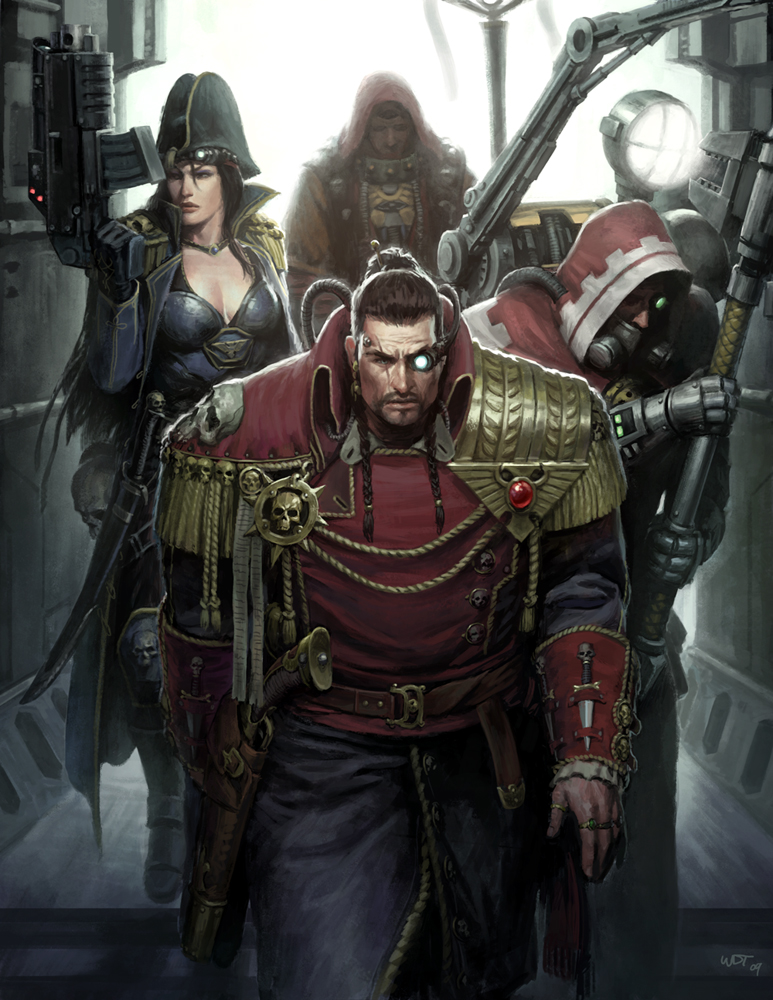
A Sister of Battle and a High Priest! Long live the Emperor!

And what makes this year so special? Well, I got shanghaied into being the game programming director at Dragon*Con. That means I was in charge of game panels. Things like Dungeon Design 101, How to Make a Better Character - things like that.


This year, we were able to get some fairly esteemed guests to our game panels. For our two indie games panels, we got Fred Hicks, who is responsible for creating Spirit of the Century and the recently and highly successful Dresden Files game.

Fred was at Dragon*Con just to hang out with Jim Butcher, the author of the Dresden Files books. Turns out these two were old friends that go way back. And not only that Jim Butcher's agent happened to be a gamer-geek, so she got him to put forth his material in RPG form.

Also, appearing in our panels was Jason Bulmahn, the lead designer for the Pathfinder RPG. Jason, too, arrived at Dragon*Con by way of vacation and was kind enough to sit in some panels for us as well.

Finally, we had Eloy LaSanta, who, while not as giant a personality as Bulmahn or Hicks, is living the dream that all gamers have - he has his own gaming company and is actually in the black. He's putting out his own games, game systems, and game worlds and getting returns. And he has one Hell of a combat system, I must say.


But we didn't just draw people from the pen and paper side of things. We also had Michael Capps, who is the CEO of Epic Games. Epic produces the Unreal engine, which is used for most of the console games you see nowadays for anything from the recent Transformers game to Batman: Arkham Asylum. But Epic is best known for producing both of the Gears of War games.

Mike literally hopped off of a plane coming from San Francisco where he shared the stage with Steve Jobs touting his latest upcoming game - Project Sword - to be on a panel with me. That, my friends, is the definition of graciousness. To come from a big, thousand plus sized hall and rush to be in a room with just 100 people for my lil' old panel...well that's just class right there.


Here's the presentation that Mike was at just before he joined me at Dragon*Con.

Coming with Mike was Alexander Macris and Julianne Capps. They were, respectively, the CEO of Themis Media and former Editor-in-Chief of the Escapist Magazine. Not ringing any bells? Well, Themis runs the award-winning Escapist Magazine site. Still not ringing any bells? The Escapist hosts Yahtzee - the famed "No Punctuation Critic". If you haven't seen or heard of Yahtzee, well you just lost some geek cred. No worries, though. Check out his reviews of video games. They're friggin' hilarious. How that guy maintains his level of comedy year after year is beyond me.

Alexander, it turns out, is a huge D&D nerd so we kibitzed about that quite a bit. It all led up to Mike, Alexander, Julianne playing in a game of 3:16 Carnage Across the Stars. We were joined by Alexander's VP Newton Grant and some long time friends of mine, Doug and Melanie.

And, you know, I have to really give credit to the Minions of the Monster Master for being able to introduce this cool group of people to 3:16. We all had a blast while playing it and even after the con, these folks were still emailing me about the game.

Other games played were Weird War II, using the Savage Worlds system. In a nutshell, think Castle Wolfenstein. Put Nazis, zombies, and Cthulhu into the same soup and you have yourself a game. Again, anyone from the Minions podcast would be familiar with this setting, since my pre-generated characters for the scenario were from a campaign we all played together.

Finally, I also got to play Zombie Cinema, which was introduced to me by the Minions. That was very interesting because what should have been an hour to hour-and-a-half game turned into a four hour deep-roleplay experience. If you haven't checked out Zombie Cinema, it's one of my favorite RPGs of all time. It has no GM. No character sheets. No stats. And yet can often yield very powerful role-play experiences.

But despite all of this gaming goodness, the highlight of the weekend had to be me getting to see Stan Lee. Back in the day, Stan Lee could come to Dragon*Con and you could walk up and just say hi. While he was always popular since the launch of the Marvel movie franchises he's a little more in demand. He nearly filled a 1600 seat hall with people wanting to see him. The wait in line for Stan was nearly two hours long. But it was worth it, because we were just three rows back from the front and could see everything quite well.

And, of course, you cannot leave Dragon*Con without a one-on-one celebrity moment. My celeb moment this year was getting to hang out with Brent Spiner for about five minutes. I was fortunately enough to catch him at a good time when the line to see him was light. I paid my money for an autograph and chatted with him about Star Trek and his random cameo on the new show, Leverage.

Of course, I would be completely remiss if I didn't mention my Dragon*Con friends that I saw as well - people that I get to see about once a year at Dragon*Con. Many of my friends are now staffers of the convention like myself, but I'm happy to have seen Dave, Joe, Beau, Shaun (both of them), Rebekah and her new significant other, Rob. Perhaps my only regret this Dragon*Con is that I didn't see more of them.

Two of my players were there - Nick and Doug. The guy who plays the battle-pskyer and the seneschal, respectively. Nick was brave enough to attempt to indoctrinate his fiancee into the convention scene. A complete and total geek-virgin, Jen bravely wandered about the convention taking everything in. To understand how uninitiated Jen is...she didn't even know what Lord of the Rings was until Nick introduced it to her. (I am exaggerating...but only a little.)

One more time, I have to give out major props to the Minions of the Monster Master. While I was at the convention, I met lots of hardcore gamers and game designers. But I was more well versed in the wide variety of RPG games out on the market than most folks that I knew. Most everyone I talked to had no idea about 3:16, Zombie Cinema, With Great Power, or Dogs of the Vineyard. And I have to really give credit to Duck Sauce and the gang for continually exposing me to new games and new experiences all of the time.

Anyhow, that's all for now.

Friday, September 10, 2010

And Now We Pause for some the...how do you say? Battlefleet Gothic

So, a while back one of my buddies got back from Saudi Arabia and we were able to get involved in a game of Battlefleet Gothic. Like a lot of the other defunct Games Workshop games, it's pretty awesome. The game works well on its own and has not suffered from the bloat of numerous rules upgrades and modifications. So it's easy to jump into.

The game is a tight little skirmish game, which employs about seven to five minis to a side. Not at all a big investment for a Games Workshop game. The ships controls and combat are not unlike the controls in Rogue Trader. Ships in motion must move forwards a minimum distance before engaging in a turn. Moving faster than normal or turning sharper than normal requires a special order. Each ship can only receive one special order per turn.

Just like in most Games Workshop games, the combat turn is divided into phases - a movement phase, firing phase, and ordinance phase. Attacks are rolled on a chart, which is modified by range, and the target's ships position relative to yours. Again, like most GW games, the combat is all resolved on the same chart, making it easy to look up and resolve.

Probably the most fun thing about the combat for me was the impact clouds. When a ship is hit, blast tokens are placed on the table at the point of impact. Flying through a blast token causes a ship to move slower and possibly take damage. So, as the battle continues, the battlefield quickly fills up with blast tokens, which function as a sort of terrain. The randomized, shifting-and-moving terrain made the game chaotic and fun. It really helped capture the sense of a massive space battle.

So how did the game go? I'll let the pictures do the talking.


Here's my fleet. Three chaos battlecruisers and four escorts (frigate class).


My opponent's fleet. Imperial cruisers! The two smaller ships are frigates.


To give you an idea of scope in the 40k universe...yes, the small ships are escorts, which is sort of like a Raider in Rogue Trader RPG. The next smallest class are the frigates, which are sort of the default vessel of Rogue Trader. I think it's mind-blowing that most of the massive and grand ships of the Rogue Trader game are just 1 hit fodder in this skirmish-level game.

Here are some more shots, just because they look good and the pictures turned out well.


I love the look of the Chaos cruisers the best. So many spines. So very Ridley Scott.


The heavily armoured prow of an imperial cruiser. What would end up being my downfall.


More spines!

Right. So onto the important stuff. How did I fare? Not well, I'm afraid. Not to say that I didn't have a blast, because I did. But in the end I literally had my arse handed to me. Basically, my opponent did a good job at spreading himself out and getting me to spread out my attacks so that I could not concentrate fire enough to take out many of his ships at all. All of his vessels took some hits, but only one or two took enough to become disabled.

But if it says anything about the game, I thoroughly enjoyed it, despite the fact that I lost so badly.


Since forward movement and momentum are inherent, its quite easy for two ships to sail on past each other, firing salvos at each other the entire time. Very naval. Very cinematic. And very different from what I'm used to in a minis game.


Here you can see the real thick of it. Ships right on top of each other. Blast tokens creating that spontaneous terrain that I'm talking about. If Chaos is going to go out, what better way to go out?

Well that's all for now. Next time, I'll give the low-down on Dragon*Con.

Wednesday, September 8, 2010

Tenth Session - Prophecy and Fortelling


After a successful raid of the Space Hulk, our intrepid Explorers then made the rest of the journey to Footfall. There, they picked up their new Astropath, who happened to be a new player.

Rob, our new guy, gravitated towards the Astropath career after learning that the crew had lost their first one. Interesting, considering that the first Astropath was just an NPC. I'm sure there were other factors in his decision-making, but there you have it.

After disembarking on Footfall, the crew was met by a large platoon of Kroot mercenaries, who offered their services. The Kroot come fresh out of Into the Storm, and I was happy to incorporate them into the campaign. The Arch-Militant got fitted for some new power armor and then it was time to get more plot-heavy.

The Explorers were invited to a Fortelling - a great prophecy that bends the future itself. This particular Fortelling was put out by the Witch of Footfall. Actually, there are seven witches in Footfall, but in my campaign there's only the one. One can win a seat at the Fortelling but you have to bid at an auction to do so.

(If any of this seems familiar, the whole scenario comes straight out of Lure of the Expanse, which what I'm currently mining for ideas. )

In any event, the auction isn't one for money but instead for...something curious. Like the toenail of a daemon, ten-thousand blind servants from hive world of Necromunda, or the last sonnet composed by long-dead Sister of Battle. In an unexpected turn of events, the Explorers bid the Senechal's missing memories which he's been wanting to get back for over a decade, now. Yet another reason I'm loving the game and the setting - you can actually do things like that with real consequences. Now, the Senechal will never get to see his hidden backstory. He will never get to know what was taken from his mind.

The crew was able to be present at the Fortelling, though, when all was said and done.

A great presence awakens
But the prophets shall arrive
With their White Light before them
The claw, taloned - shall stir

And lo, near the four suns, a treasure emerges from a Dead World
A great prize to be claimed by those who fear neither Fate or Destiny
And she shall be the key to the awakening
Its slumber
She shall be its key.
All will be revealed with the coming of the Great War

Then, in the middle of the Fortelling, Footfall was attacked, by the mysterious and infamous Null Fleet, a group of bad guys I used for my last campaign. In the next session, we'll have our climactic finish was the Explorers say farewell to a dear friend.


Thursday, August 26, 2010

Character Journal 3 - H. Tiberius Holocene


Day 267, 813M41
Log of Events
Ferral Wolf, comissioned 389M34
Captain H. Tiberius Odysean Holocene

Warrant of Trade # RV-426-G7-96-BFN4Y2
Granted to Rogue Trader Hester Nathaniel Holocene 623M35 327M31
Given leave to spread the light of the God Emperor to places unknown within Segmentum Obscurus.

How do you measure the value of a life?

It is a question that every leader worth his salt must face, even Rogue Traders. I have sent men to their deaths, lost soldiers in battle. I have even left people to die and made decisions that cost the lives of thousands of souls. I tell myself that the sacrifices are necessary; sealing off a burning compartment on my ship might kill hundreds, but save everyone else, tens of thousands of people who rely on me to make the right decision. I have commanded warriors to stand and fight in futility or to advance straight into corruption. But I will never be able to forget the screams of those burning alive, or the sight of men being ripped to pieces at the hands of an Ork horde. Despite these memories, I have always been able to remind myself why I do these things.

How can I let the fate of one life, or even a thousand lives stand in the way of destiny?

I am the progenitor of the Holocene Dynasty. Sending men to their deaths is a part of that. The decisions I make will someday influence entire star systems, billions of people. I will not fail my ancestors, I will not allow our line to fall into oblivion.

And yet...

Losing Sitara was a hammer blow. Though I rarely had opportunity to express them, I cannot deny the feelings I had for her. Love is probably too strong a word, but there was caring and compassion to be sure. She smiled only rarely, but when she did, it brightened my day. Watching her get ripped to shreds by the... thing under the city was devastating.

Suddenly my understanding of my destiny was cast into shadow. If her fate meant so much to me, what of the fates of all the rest who serve under my command, who toil for the name Holocene. How can one man be held responsible for so many? How can I continue to choose to send men into battle, or one of a hundred other gruesome ends?

I wish, for a fleeting moment, that I were someone else; a lowly serf. Riches and fame seem ill-equipped to offset this price, this burden I must bear.

I find myself unsure as to my next course of action. This is unnerving to say the least. I know that I am still tasked with leading this crew, this dynasty. What if I make the wrong choice?

Wednesday, August 11, 2010

ALL STOP - Into the Storm - a review


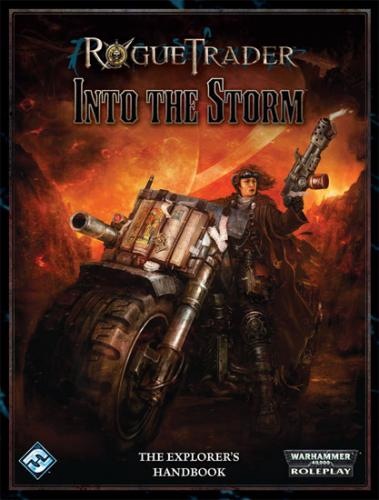
A buddy of mine, who happens to be a player in my Rouge Trader game went to Gen Con this week and picked up Into the Storm. So, here's my review of the new book, after having it for only three days.

If you don't know what Into the Storm is, it's an upgrade book or "player's guide" for the Rogue Trader game. So far, this book seems to me to be what The Inquisitor's Handbook was to Dark Heresy. And that is certainly a good thing.

Chapter One: Advanced Origins

One of the more innovative things I enjoy about the Rogue Trader system is its Origin Path system for character creation. It's a real help because it helps focus character backgrounds and creation in a massive universe of options and realities.

Chapter One greatly expands upon the Origin Path system and keeps it backwards compatible by introducing alternate origins at each station. For example, instead of starting out on a Death World, you can start out on a Death World or a Frontier World, which gives different benefits and penalties. Moving down from that, you could pick Scavenger or Fringe Survivor, etc. And on top of that, each of the new origin picks has three different variations to choose from as well. If you choose to be a Fringe Survivor, you could be a Survivalist, Heretek, or Pit-Fighter. (Warhammer Quest anyone?)

All of these new Origin paths do cost xp, however. So people looking to go crazy and power-mad are reined in a bit. I'm going to certainly offer these new Origin Paths retroactively to my players, because many of them are much better fits for their characters.

Another row of Origins is added as well: Lineage. Lineage is an Origin aspect which describes your family and their reputation.

Another cool edition - an Origin path for the Explorer's Warrant of Trade. This is very neat. In this section, the players and GM sit down together and decide the general history and background of the very Warrant they hold. Doing so determines the group's starting Profit Factor and Ship Points.

Chapter Two: Koronus Careers

This section of the book contains information the both expands on the initial Rogue Trader classes and introduces new elements to the game. I will tell you right now that this is the section that introduces the Kroot and Ork Freebooter races to the game. Unfortunately, neither race is given its own Origin chart, and they are stuck with a single career choice - Kroot Mercenary or Ork Freebooter. They do, however, have a slew of Talents and other abilities that set them off from humans. The Kroot, for example, can gain hit points by eating their slain opponents.

Thereafter, the book describes Alternate Career ranks. Just like in Dark Heresy, alternate career ranks are special ranks which can be taken instead of the next level on the line. After your alternate rank, you go back to the ranks in your regular career. Some of the alternate ranks are more specific than others. For example, the Acquisitionist can be only taken by the Seneschal. Some are very setting specific, like the Drusian Adherent. However, many of the alternate career ranks are open - able to be taken by any of the career paths.

The end of the chapter features a few Elite Advances. Two of them are are open to most careers, while some like the Rite of Duplessence and the Sanctioned Xenos are career specific.

Chapter Three: Extended Armoury

This chapter features, as you might expect, a lot more weapons and equipment. I didn't know how much they could expand the weapons list from the Inquisitor's Handbook, but they did it. Noteworthy are the expanded types of grenades and ammunition; as well as a fair number of xenos equipment.

Chapter Four: Starships Expanded

This section offers a brief write up on ship life and then goes into expanding the ship options in Rogue Trader. More hull types are present. Many should seem familiar to fans of Battlefleet Gothic, like the Firestorm frigate or the Lathe-class monitor cruiser. Also added are ship background packages. You can buy these with ship points, and are like backgrounds you can pick for your ship, rather than roll for.

There are also ship upgrades like better Warp engines, additional Void shields, or different ship weapons like missile batteries. Finally, there are interesting ship upgrades like giving your vessel vaulted ceilings (morale increase) or even buying an atomic weapon. But you can only buy one nuke at a time.

Chapter Five: Vehicles

This is perhaps the most valuable portion of the book, since it gives stats and rules for vehicles, something missing from both Dark Heresy and Death Watch. There is an old web book out there with vehicles and vehicle rules for Dark Heresy, but those rules were much more on the narrative side and sort of filler for a gap in the rules.

The vehicle rules are not unlike the rules for ships, though obviously they work on different scale. Each vehicle has a degree of armor and structural integrity. When it starts taking Structural Integrity damage, it starts taking critical wounds, much like a character.

Chapter Six: Expanded Psychic Powers

This section includes new Navigator powers as well as new Astropathic powers. None of the powers that I saw in my quick glance seemed to be redundant, as can happen in systems of this nature. There is also a new psychic school, which is Theosophamy - a school which focuses on manipulating the Warp itself for its own sake. The powers included allow the psyker to do such things as attempt to banish daemons and the like (it's not easy), or make one's weapon into a Warp Weapon.

Chapter Seven: Enhanced Game Mechanics

Chapter Seven is almost an appendix, with a number of rules upgrades or mechanics ideas in place for GMs to use or not. There is a small section on Social Interaction challenges, not unlike an Exploration challenge.

The book also introduces Meta and Background Endeavours. Meta Endeavours are large, campaign-spanning Endeavours which are meant to be either an outline for your campaign or something close to it. I rather liked this write up. It shows how Endeavours can be used to outline an entire campaign, even if you run it sandbox style.

The addition of Background Endeavours is nice as well. It allows the PCs to set up long-term tedious tasks to be accomplished by NPCs so that the party can go do exciting stuff.

This chapter also introduces ideas to make Acquisition Tests and Profit Factor more interesting. For example, if the Rouge Trader group keeps on spending extravagant amounts of money, they can attract unwanted attention.

Finally, there is an expansive look at then different roles on a Rogue Trader ship, what they do, and where they operate. I also enjoyed this section, because ship-board drama is something I wanted to cover in my campaign, and this section is great for ideas for just that.

Chapter Eight: Port Wander

Obviously, this is a detailed write up on Port Wander. Footfall, of course, is covered in Lure of the Expanse.

Thursday, August 5, 2010

Ninth Session - SPACE HULK


Well, after a number of disastrous rolls by the Navigator of our Explorer's crew, I had a choice to make. I could put them waaaay off course and roll on the table to determine what ill befell them. Or, I could use one of the three pre-scripted "events" that I had developed for just such an occasion before the campaign started.

Hmm. Which did I pick? It's not hard to guess.

The Space Hulk

The Explorers' ship was set far off course by the turbulent warp, but in its meanderings, their two vessels ran across something quite interesting - a Space Hulk. As most people here know, a Space Hulk is a piece of cosmic mass, fused together with the hulls of numerous ships that were lost in the Warp at one point and time. The Space Hulk the crew found was exceptionally large, containing the carcasses of numerous battleships, cruisers, and frigates - not all of them human.

Essentially, I used the adventure found in the Purge the Unclean adventure compilation as the basis for the encounter. Obviously, what I did and used was highly modified. However, the players still had the opportunity to pick up both the Luminous Reproach (an ancient Inquisitorial power sword) and the Liber Daemonica (a powerful text of forbidden lore).


The Black Ship

The basis of the Purge the Unclean adventure is that within a Space Hulk the Inquisition discovers the lost transponder signal of a famous Inquisitor's ship. And this Inquisitor was famed to have owned a very powerful daemon's bane weapon. Instead of telling the party that up front, however, I allowed them to sort of "discover" this as they went in.

The party had to deal with strange sightings. Things moving out of the corner of their eyes, and shadows that seemed to have a life of their own. This all culminated in the party winding up in an Inquisitorial Black Ship. It was only after a few rolls that the party slowly started to piece together where they were. A few additional rolls allowed the RT to realize that they were on the Dark Victory, a vessel for a famous Inquisitor who possessed a powerful sword - the Luminous Reproach. While the ship's name changed, many of the other details came from Purge the Unclean.

The Fight

Fortunately, the crew was smart enough to bring a platoon of armed men with them. Their platoon was half made up of their highly-trained honour guard and the other half was made up of guards from the crew of the Lucien's Folly - the ship whose crew they recused from destruction. Otherwise, fighting over 50 psykers might have been daunting. Even for a powerful Rogue Trader crew.

The way I staged it was with my familiar microcosm/macrocosm houseruling. A few statted out psykers represented the main threat, fought against by the PCs. Around these main threats, I placed some simple pente stones to represent the mob of pskyers all around them. I explained that the pente stones were only there to be a visual representation. They were not really "there" in terms of fighting, choosing targets, etc. The PCs' men were represented with dice in a similar fashion.

Before the battle could be finished, two Dark Eldar arrived with their warp beasts in tow. The battle became a three-way conflict.

In the end, Ergan Wright was injured. The crew had the rest of his men escort him back to the Ferral Wolf. To see how successful they were in their escort, I had the party make a series of rolls, not unlike an Exploration test. They fell short of the mark so I had them choose. Did the rest of the guard from the Lucien's Folly perish? Or would it be their precious honour guard? The crew chose to sacrifice their honour guard...which means, now, they their well-trained guardsmen are unfortunately gone for good.


Temptations and Weirdness

Not wanting to leave completely empty handed, the Explorers decided to look for the famous Luminous Reproach. After much searching, the Explorers encountered a number of weird events, like time-looping ghosts and corridors which seemed to appear and disappear.

One of these events was an opportunity to reclaim the Liber Daemonica. However, the party decided not to. If you remember, the Rogue Trader's rash actions had already resulted in the loss of their Astropath. He didn't want to be quite as reckless a second time around.

This is was pretty cool from a roleplaying standpoint for me. A character actually learning from his mistakes. Mistakes made while in character.

Real Consequences for Hard Things

What I really liked about this session was the fact that the characters attempted something difficult (raiding a space hulk), got something special for it (a very powerful daemon-bane sword), but paid a real price for it.

Typically, in a D&D situation, the party might go on a quest and enter a dungeon. The dungeon may be even really hard if the quest is big enough. But what usually happens is that the party survives (perhaps barely) and they get their reward. Thereafter, they are healed of all wounds. Even of some of them die...they can always be brought back. Usually there is very little long term effect from a difficult dungeon.

Here, however, we have a completely different situation. The loss of the honour guard means that the Arch-Militant lost good men. Men he hand picked and hand trained, which also reduces the stats of any of their personal guard as well. But out of this great loss comes a very interesting story - of how the remaining guard of the Lucien's Folly became the new honour guard of the Rogue Trader dynasty.

How cool is that? The honour guard in the Rogue Trader game aren't just some nameless shmoes who signed up for the job, but were chosen for an in-game reason and as a result of an in-game narrative.

Very cool indeed.

Saturday, July 31, 2010

Music in My Games

I use a lot of music in my games. In my opinion, not only does it add to the experience, but it helps ground me into the scene. It reminds me what is going on and what I'm going for in any given scene.

For every campaign I run, I try to craft a particular "soundtrack" for it. Meaning, I'll assemble a collection of albums and songs from my larger library that fits the campaign and setting. If you're interested in doing this kind of thing, you really don't need a massive library of music. When I first got started, I only had about 3 or 4 albums that I used all of the time.

If you've never used music before, the best way to get into using music with your games is to put it on in the background. So here's a list of music that might work for you as simple background stuff for your games:

For Combat


If you just want some exciting music for your games - to play while combat is running, for instance - I can't recommend the Epic Score group enough. Basically these are albums filled with epic-sounding music that you can just put on in the background during a fight and never have to worry about what track you're on. Also, I'd recommend the Savage Tongue by Ars Arcana for the same reason. As an interesting aside, if you listen carefully, you'll note that you've probably heard a lot of Epic Action stuff from movie trailers, commercials, or TV shows.

Also, Epic Action does a lot of work with tense and thrilling music as well. I don't have any of that material, however, so I cannot comment on that.

Follow the links above, and you'll find some great samples of their music.

For Mystery


Mystery, creepiness, and the unknown are strong themes in the 40k universe. After all, there's always the Warp and the constant threat of it.

For my games in Rogue Trader, I've been using a lot of the creepy tracks from Mel Gibson's version of Hamlet. However, that album is out of distribution.

So, if you're interested in picking up some generally creepy and mysterious music, I'll recommend Midnight Syndicate, and the Riven soundtrack. Midnight Syndicate is full of creepy music and sound effects. You can just put it and and let it ride without much worry. The one problem with it, however, is that its mostly gothic horror, which may not mesh well with a space opera.

The Riven soundtrack, however, fits very well with Rogue Trader. And it's readily available anywhere.

For Downtime


It may seem odd, but some of the most used music I have is what I call "downtime music" - music for when the party is just sitting around chatting. It's used quite often, because quite a good amount of time is spent having the Explorers interact with one another. For this, I would highly recommend the score for the HBO series - The Tudors. While the music is meant to be evocative of Renaissance Europe, it fits Rogue Trader because the 40k universe is one with archaic trappings.

Also, there are a number of great music tracks on the Mass Effect 1 and 2 soundtracks. While these tracks are much more evocative of a futuristic and sci-fi setting, you cannot just put in a Mass Effect music album and hit play. Only some of the tracks will end up working for you, so be ready to make a playlist of the tracks you want.